importnumpyasnpa=np.array([[1357911][24681012]])# horizontal splittingprint('Splitting along horizontal axis into 2 parts:n'np.hsplit(a2))# vertical splittingprint('nSplitting along vertical axis into 2 parts:n'np.vsplit(a2))
Terminas transliavimas apibūdina, kaip NumPy apdoroja skirtingų formų masyvus atliekant aritmetines operacijas. Atsižvelgiant į tam tikrus apribojimus, mažesnis masyvas yra „transliuojamas“ per didesnį masyvą, kad būtų suderinamos formos. Transliavimas suteikia galimybę vektorizuoti masyvo operacijas, kad kilpa būtų C, o ne Python. Tai daroma nedarydamas nereikalingų duomenų kopijų ir paprastai užtikrina efektyvų algoritmo įgyvendinimą. Taip pat yra atvejų, kai transliavimas yra bloga idėja, nes dėl to neefektyviai naudojama atmintis, o tai lėtina skaičiavimą. NumPy operacijos paprastai atliekamos po kiekvieno elemento, todėl reikia, kad du masyvai būtų visiškai vienodos formos. Numpy transliavimo taisyklė atpalaiduoja šį apribojimą, kai masyvų formos atitinka tam tikrus apribojimus. Transliacijos taisyklė: Norint transliuoti abiejų masyvų galinių ašių dydį operacijos metu turi būti arba vienodo dydžio, arba viena iš jų turi būti vienas . Let us see some examples:
A(2-D array): 4 x 3 B(1-D array): 3 Result : 4 x 3
A(4-D array): 7 x 1 x 6 x 1 B(3-D array): 3 x 1 x 5 Result : 7 x 3 x 6 x 5
But this would be a mismatch:
A: 4 x 3 B: 4
The simplest broadcasting example occurs when an array and a scalar value are combined in an operation. Consider the example given below: Python
importnumpyasnpa=np.array([1.02.03.0])# Example 1b=2.0print(a*b)# Example 2c=[2.02.02.0]print(a*c)
Output:
[ 2. 4. 6.] [ 2. 4. 6.]
We can think of the scalar b being stretched during the arithmetic operation into an array with the same shape as a. The new elements in b as shown in above figure are simply copies of the original scalar. Although the stretching analogy is only conceptual. Numpy is smart enough to use the original scalar value without actually making copies so that broadcasting operations are as memory and computationally efficient as possible. Because Example 1 moves less memory (b is a scalar not an array) around during the multiplication it is about 10% faster than Example 2 using the standard numpy on Windows 2000 with one million element arrays! The figure below makes the concept more clear: In above example the scalar b is stretched to become an array of with the same shape as a so the shapes are compatible for element-by-element multiplication. Now let us see an example where both arrays get stretched. Python
Kai kuriais atvejais transliavimas ištempia abu masyvus, kad susidarytų išvesties masyvas, didesnis nei bet kuri iš pradinių masyvų.
Darbas su data ir laikas:
Numpy has core array data types which natively support datetime functionality. The data type is called datetime64 so named because datetime is already taken by the datetime library included in Python. Consider the example below for some examples: Python
importnumpyasnp# creating a datetoday=np.datetime64('2017-02-12')print('Date is:'today)print('Year is:'np.datetime64(today'Y'))# creating array of dates in a monthdates=np.arange('2017-02''2017-03'dtype='datetime64[D]')print('nDates of February 2017:n'dates)print('Today is February:'todayindates)# arithmetic operation on datesdur=np.datetime64('2017-05-22')-np.datetime64('2016-05-22')print('nNo. of days:'dur)print('No. of weeks:'np.timedelta64(dur'W'))# sorting datesa=np.array(['2017-02-12''2016-10-13''2019-05-22']dtype='datetime64')print('nDates in sorted order:'np.sort(a))
Output:
Date is: 2017-02-12 Year is: 2017 Dates of February 2017: ['2017-02-01' '2017-02-02' '2017-02-03' '2017-02-04' '2017-02-05' '2017-02-06' '2017-02-07' '2017-02-08' '2017-02-09' '2017-02-10' '2017-02-11' '2017-02-12' '2017-02-13' '2017-02-14' '2017-02-15' '2017-02-16' '2017-02-17' '2017-02-18' '2017-02-19' '2017-02-20' '2017-02-21' '2017-02-22' '2017-02-23' '2017-02-24' '2017-02-25' '2017-02-26' '2017-02-27' '2017-02-28'] Today is February: True No. of days: 365 days No. of weeks: 52 weeks Dates in sorted order: ['2016-10-13' '2017-02-12' '2019-05-22']
Tiesinė algebra NumPy:
„NumPy“ linijinės algebros modulis siūlo įvairius metodus, kaip taikyti linijinę algebrą bet kokiame nelygiame masyve. Galite rasti:
rango determinantas pėdsakas ir tt masyvo.
savo vertybes ar matricas
matricos ir vektoriaus sandaugai (taškas vidinis išorinis ir kt. sandauga) matricos eksponencija
išspręskite tiesines arba tenzorines lygtis ir dar daugiau!
Consider the example below which explains how we can use NumPy to do some matrix operations. Python
importnumpyasnpA=np.array([[611][4-25][287]])print('Rank of A:'np.linalg.matrix_rank(A))print('nTrace of A:'np.trace(A))print('nDeterminant of A:'np.linalg.det(A))print('nInverse of A:n'np.linalg.inv(A))print('nMatrix A raised to power 3:n'np.linalg.matrix_power(A3))
Output:
Rank of A: 3 Trace of A: 11 Determinant of A: -306.0 Inverse of A: [[ 0.17647059 -0.00326797 -0.02287582] [ 0.05882353 -0.13071895 0.08496732] [-0.11764706 0.1503268 0.05228758]] Matrix A raised to power 3: [[336 162 228] [406 162 469] [698 702 905]]
Let us assume that we want to solve this linear equation set:
x + 2*y = 8 3*x + 4*y = 18
This problem can be solved using linalg.išspręsti method as shown in example below: Python
importnumpyasnp# coefficientsa=np.array([[12][34]])# constantsb=np.array([818])print('Solution of linear equations:'np.linalg.solve(ab))
Output:
Solution of linear equations: [ 2. 3.]
Finally we see an example which shows how one can perform linear regression using least squares method. A linear regression line is of the form w1 x + w 2 = y ir tai yra linija, kuri sumažina atstumo nuo kiekvieno duomenų taško iki linijos kvadratų sumą. Taigi, atsižvelgiant į n duomenų porų (xi yi), mes ieškome parametrų w1 ir w2, kurie sumažina klaidą: Let us have a look at the example below: Python
importnumpyasnpimportmatplotlib.pyplotasplt# x co-ordinatesx=np.arange(09)A=np.array([xnp.ones(9)])# linearly generated sequencey=[192020.521.522232325.524]# obtaining the parameters of regression linew=np.linalg.lstsq(A.Ty)[0]# plotting the lineline=w[0]*x+w[1]# regression lineplt.plot(xline'r-')plt.plot(xy'o')plt.show()
Output: Taigi, tai veda prie šios NumPy vadovėlio serijos pabaigos. NumPy yra plačiai naudojama bendrosios paskirties biblioteka, kuri yra daugelio kitų skaičiavimo bibliotekų, tokių kaip scipy scikit-learn tensorflow matplotlib opencv ir kt., pagrindas. Pagrindinis NumPy supratimas padeda efektyviai dirbti su kitomis aukštesnio lygio bibliotekomis! Nuorodos:

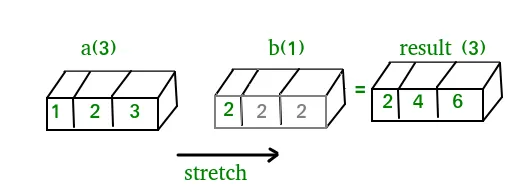 In above example the scalar b is stretched to become an array of with the same shape as a so the shapes are compatible for element-by-element multiplication. Now let us see an example where both arrays get stretched. Python
 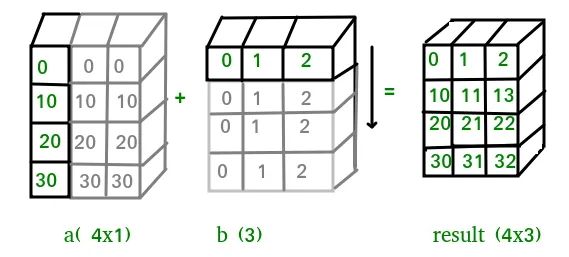 Kai kuriais atvejais transliavimas ištempia abu masyvus, kad susidarytų išvesties masyvas, didesnis nei bet kuri iš pradinių masyvų.
 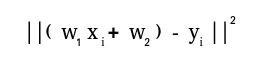 Let us have a look at the example below: Python
 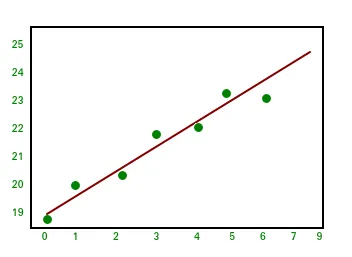 Taigi, tai veda prie šios NumPy vadovėlio serijos pabaigos. NumPy yra plačiai naudojama bendrosios paskirties biblioteka, kuri yra daugelio kitų skaičiavimo bibliotekų, tokių kaip scipy scikit-learn tensorflow matplotlib opencv ir kt., pagrindas. Pagrindinis NumPy supratimas padeda efektyviai dirbti su kitomis aukštesnio lygio bibliotekomis! Nuorodos: